The Electric Car: Development and Future of Battery, Hybrid and Fuel-Cell Cars
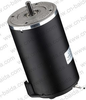
The conversion of electrical power to mechanical power is fundamental in making an electric vehicle possible. The early days of electric propulsion are described in Chapter 2, and from those early days until the 1960s DC motors were always used to convert electrical energy to mechanical power at the driving wheels, since the power from the battery was immediately available in direct current form, and could be controlled by voltage switching and variation of field and armature circuit resistance and more recently by high speed on-off switching of the battery supply (the chopper ). Both these and more recent control methods are described in detail in Chapter 4.
Since the 1960s and the appearance of electronic power switching devices suitable for high-current applications, it has been possible to convert direct current from the battery to alternating current of variable frequency and amplitude, thus making practicable the use of both induction motors and synchronous motors. The use of these AC machines has shown considerable advantages in cost, size, weight and reliability.
This chapter describes the way these different categories of motor operate and their advantages and disadvantages when used in electric vehicles. The switched reluctance motor, the brushless DC motor and the disc motor are also described and their possible application in future electric vehicles considered.
The principle of the DC motor is shown in Figure 3.1. In this case a simplified two-pole DC machine is shown in which a rotor (or armature) has a number of coils...