The Electric Car: Development and Future of Battery, Hybrid and Fuel-Cell Cars
5.9: Sodium-sulphur

5.9 Sodium-sulphur

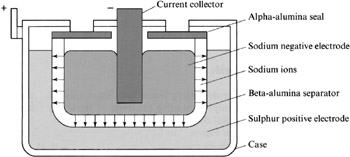
The sodium-sulphur battery was first developed in the Ford Research Laboratories in Dearborn, USA in the 1960s as a new approach to solving the problem of a battery with sufficient energy density and power for an electric vehicle. It is constructed with a positive current collector containing a liquid sulphur positive electrode separated by a beta-alumina separator from a sodium electrolyte in which a metallic negative electrode is embedded (see Figure 5.4). During discharge, sodium ions produced at the negative electrode are transported through the porous separator to the liquid sulphur positive electrode, reducing some of the sulphur to polysulphide ions.


Figure 5.4: Sodium-sulphur battery cell

For the battery to operate effectively it is necessary to maintain its temperature at about 350 C and this requires the use of sophisticated methods of construction for the battery pack, together with auxiliary heating during charging and periods of non-use. It is essential that the battery is not allowed to cool below 200 C, as the sodium electrolyte freezes solid at this temperature. Reactivation then becomes slow and difficult and the freezing of the sodium can damage the battery because of the mechanical stresses introduced.

The sodium-sulphur battery has a high-energy density of 110 Wh/kg, a high power density of 150 W/kg and is capable of 1000 cycles of deep discharge in use.

There is concern about the potential problems which could be caused by the leakage of the corrosive materials used in the battery if the vehicle is involved in an accident.

UNLIMITED FREE
ACCESS
TO THE WORLD'S BEST IDEAS

SUBMIT
Already a GlobalSpec user? Log in.

This is embarrasing...

An error occurred while processing the form. Please try again in a few minutes.

Customize Your GlobalSpec Experience

Category: Electrolytes
Finish!
Privacy Policy

This is embarrasing...

An error occurred while processing the form. Please try again in a few minutes.