Engineering Analysis with ANSYS Software

Chapter 7: Application of ANSYS to Contact Between Machine Elements

7.1 GENERAL CHARACTERISTICS OF CONTACT PROBLEMS

In almost every mechanical device, constituent components are in either rolling or sliding contact. In most cases, contacting surfaces are non-conforming so that the area through which the load is transmitted is very small, even after some surface deformation, and the pressures and local stresses are very high. Unless purposefully designed for the load and life expected of it, the component may fail by early general wear or by local fatigue failure. The magnitude of the damage is a function of the materials and the intensity of the applied load as well as the surface finish, lubrication, and relative motion.

The intensity of the load can usually be determined from equations, which are functions of the geometry of the contacting surfaces, essentially the radii of curvature, and the elastic constants of the materials. Large radii and smaller modules of elasticity give larger contact areas and lower pressures.

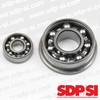
A contact is said to be conforming (concave) if the surfaces of the two elements fit exactly or even closely together without deformation. Journal bearings are an example of concave contact. Elements that have dissimilar profiles are considered to be non-conforming (convex). When brought into contact without deformation they touch first at a point, hence point contact or along line, line contact. In a ball bearing, the ball makes point contact with the inner and outer races, whereas in a roller bearing the roller makes line contact with both the races. Line contact arises when...

UNLIMITED FREE
ACCESS
TO THE WORLD'S BEST IDEAS

SUBMIT
Already a GlobalSpec user? Log in.

This is embarrasing...

An error occurred while processing the form. Please try again in a few minutes.

Customize Your GlobalSpec Experience

Category: Ball Bearings
Finish!
Privacy Policy

This is embarrasing...

An error occurred while processing the form. Please try again in a few minutes.