Engineering Ethics: An Industrial Perspective
The New York Times Abstract:
Space shuttle Columbia breaks up on re-entry to earth's atmosphere, killing all seven astronauts aboard: Col Rick D Husband, mission commander, Capt David M Brown, Dr Kalpana Chawla, Cmdr William C McCool, Lt Col Michael P Anderson, Dr. Laurel Salton Clark and Col Ilan Ramon, an Israeli; breakup occurs 40 miles above Earth and only minutes before scheduled landing at Kennedy Space Center in Florida; shower of fiery debris falls across Texas and Louisiana; NASA will activate board of independent outside experts, led by Harold W Gehman, to oversee parts of investigation; how large a setback the loss of Columbia will pose for shuttle is difficult to assess. (Sanger, 2003)
The Columbia was the first of the original four orbiters launched. Between its first launch in 1981 and final launch (mission STS-107) on January 16, 2003, it went through numerous upgrades, including a glass cockpit and second-generation main engines. However, more than 44% of its tiles and 41% of the 44 wing leading edge reinforced carbon-carbon panels were original equipment.
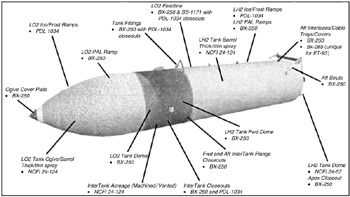
The shuttle system design, consisting of a reusable orbiter, an expendable external fuel tank carrying liquid propellants for the orbiters' engines, and two recoverable solid rocket boosters, is discussed extensively in Chapter 5. In this section, we highlight the design of the external tank insulation (Figure 12.1).