Explosively Driven Pulsed Power: Helical Magnetic Flux Compression Generators

Bruce L. Freeman and Andreas A. Neuber
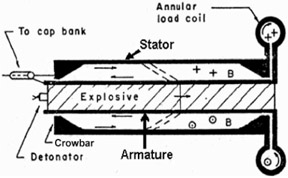
If magnetic field lines are cut or the magnetic field itself is compressed, work has been done on the system, and energy will be transferred from the mechanical system to the electrical system. In particular, the compression of the magnetic field by the action of an explosively driven piston is generally referred to as explosively driven magnetic flux compression. If the device is able to use this magnetic flux either directly or as electrical output to drive a remote load, then we have an explosive-driven magnetic flux compression generator or FCG, see Fig. 2.1 for a cylindrical FCG, which has no stator helix. In this instance, the chemical energy of the explosive is transferred into the kinetic energy of the armature, and subsequently into electrical energy. In extreme cases, the output of the FCG is limited by the kinetic energy available to transfer into electrical energy.
As a practical matter, the assessment of the generator performance based on the efficiency of converting explosive energy into electrical energy is neither a desirable viewpoint nor a useful way to design these devices.
The reasons for this are that there is generally more explosive energy available than can be productively used, and stopping the moving element, or armature, in flight leads to at least two negative...