Flight Control Systems: Practical Issues in Design and Implementation

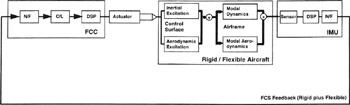
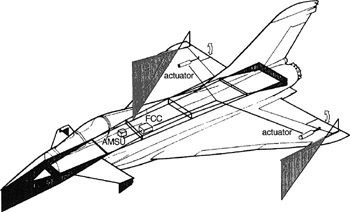
The key to solving many engineering problems lies in gaining an understanding of the system, eventually modelling it in an appropriate fashion and performing quantitative analysis. The elements of the FCS flexible-aircraft structural-coupling system are illustrated in Figure 7.1 and described below.
Aircraft, like any flexible structure, exhibit many modes of vibration, with each mode having a characteristic resonant frequency and mode shape. For example, Figure 7.2 shows a snapshot of a typical symmetric mode shape for fuselage bending which might have a resonant frequency of about 15 Hz. The plot of the mode shape indicates the relative motion between the various parts of the airframe when subject to excitation at the resonant frequency. Note the deflection in the front and mid sections of the fuselage, where the FCS sensors are located. An aircraft will have many modes within the bandwidth of the FCS, many of which will vary significantly in frequency and amplitude of response with the stores carried, fuel state and flight condition, and each of which will involve a different deflection at the sensor location.
The flexible modes may be excited or 'forced' by oscillating the aircraft's flying controls. Figure 7.3 shows the results of a ground test on the aircraft where the relative amplitude of the response of the aircraft to control surface excitation was...