Overview
A multistep input signal of arbitrary shape can be synthesized by a sequential combination of equidistant pulse inputs (see Fig. A.1a), and each pulse of a fixed duration as a difference of two time-displaced step signals; see Fig. A.1b. Accordingly, a multistep input signal u( t) in time domain can be expressed as1 3
where n P is the number of pulses (for example, seven for the case depicted in Fig. A.1a), V k the amplitudes of the individual pulses, ?( t) the unit step at time t, and ? t the time step (width) of the each pulse.
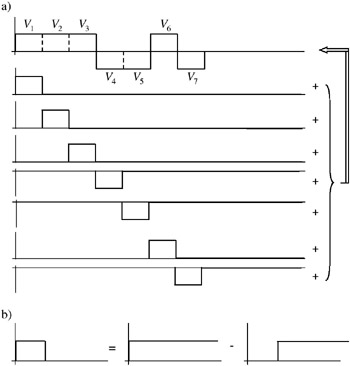 Fig. A.1: Schematic decomposition of multistep input. a) Multistep input signal, b) pulse input.
 The frequency domain transformation of Eq. (A.1) is given by
where ? is the angular frequency, e the base of the natural logarithm (a constant), and j the imaginary number. Equation (A.2) can be rewritten as
In terms of the normalized frequency ? = ? ? t, Eq. (A.3) leads to
Using the Euler s formula for the complex exponential function in terms of trigonometric functions, e jx = cos x + j sin x, where x is a real number, it turns out that e j ?/2 ? e ? j ?/2 = 2 j sin ( ?/2), which when substituted in Eq. (A.4), after minor simplification yields
Now, applying the same...


 TABLE OF CONTENTS