Handbook of Computer Crime Investigation: Forensic Tools and Technology
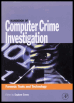
K. Edward Gibbs and David F. Clark
Wireless networks provide substantial benefits at less cost than ever before in history. Their impact is felt both by business and consumer users. Society is, and will continually be, both subtly and profoundly influenced by the ever-increasing amount of wireless network subscribers. These subscribers may not only be people but autonomous appliances that have the ability to connect to wireless networks.
In this chapter, the term mobile device refers to the instrument by which a subscriber can connect to a wireless network. A mobile device can be a tool for communications such as a mobile phone, pager, wireless LAN card, or wireless modem.
The objective of this chapter is to introduce the possible types and locations of digital evidence in a wireless network. To start the chapter, wireless networks are examined from the perspective of an investigator's interest in digital evidence. Possible areas of digital evidence are then discussed, after which circuit switched and packet switched wireless networks are examined from the perspective of locating and gathering digital evidence. Many aspects of the networks described herein can be generalized and applied to other types of wireless networks. A brief overview of Position Determining Equipment and Location Based Services is presented. The topic of Wireless LAN technology for computer networks is touched upon at the end of the chapter. Advice to readers is presented in the conclusion.
There are a variety of methods, using an assortment of technologies,...