Industrial Waste Treatment Handbook, Second Edition

Among the most effective waste management procedures is equalization of the waste stream. Equalization can be of two types: flow equalization and constituent equalization. Flow equalization refers to changing the variations in rate of flow throughout the processing and cleanup cycles to a more steady flow rate that is more nearly equal to the average flow rate for that period of time. Constituent equalization refers to the concentration of the target pollutants in the waste stream. Throughout the 24-hour day, the concentrations of individual constituents in a given industrial waste stream typically vary over wide ranges, as processes are started up, operated, shut down, and cleaned. Waste treatment systems that are designed for given ranges of concentration of target pollutants often do not perform well when those constituents are in concentrations significantly different from the design values.
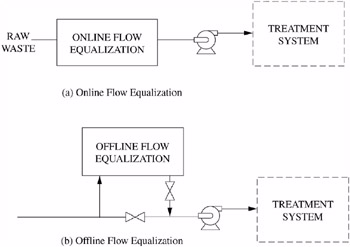
Equalization can be either online, as diagrammed in Figure 7-3(a), or off-line, as diagrammed in Figure 7-3(b). On-line flow equalization is accomplished by allowing the waste stream to flow into a basin. The waste is then transferred from the basin to the treatment system at a constant (or more nearly constant) rate. The fundamental requirement of the basin is that it be sufficiently large that it never overflows and that it always contains enough waste that it never becomes empty, causing the flow to the treatment system to stop.
As shown in Figure 7-3(b), offline equalization is accomplished by restricting the flow into the treatment system...