Internet and Wireless Security
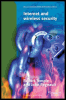
This book presents an overview of current and future infrastructures for e-business including XML security mechanisms and next generation Public Key Infrastructures (PKI).
 TABLE OF CONTENTS
 D W Parkinson
There has been an explosive growth in large-scale mobile communications systems triggered by the introduction of the total access control system (TACS) in the early 1980s. TACS was an analogue mobile telephone system, and was followed in the early 1990s by the fully digital global system for mobile communications (GSM) [1]. The launch of the new universal mobile telecommunications system (UMTS), otherwise referred to as 3G or third generation system [2], is now imminent.
In addition to these systems, we have seen the development of the digital enhanced cordless telecommunications (DECT) for cordless telephony (home, PABX), and for the professional mobile radio market the terrestrial trunked radio standard (TETRA) [3]. TETRA is becoming the system of choice for public safety organisations (police, fire, ambulance, etc) and is the basis of the BT Airwave service a public radio safety communications service [4, 5].
As the demand for data services has grown, the general packet radio service (GPRS) has been developed to meet the needs of data users in GSM, while both TETRA and UMTS have integral support for packet data services.
All these mobile communications systems are based on open standards that have been developed within the European Telecommunications Standards Institute (ETSI) [6] and its affiliated organisations (e.g. GSM Association [1], TETRA MoU [3] and the 3rd Generation Partnership Project 3GPP [2]).
One common characteristic of all these mobile communications systems is the very obvious fact that the connection between terminals and the network...