Internet and Wireless Security

This book presents an overview of current and future infrastructures for e-business including XML security mechanisms and next generation Public Key Infrastructures (PKI).
 TABLE OF CONTENTS
 While the advantages of incorporating the results of esoteric mathematical algorithms using very large numbers into a text format are not immediately apparent, the W3C have been working on just such a task.
Beginning in the middle of 1999, the XML Signature Working Group has been creating a specification for defining digital signatures in an XML format. The most recent version of the draft standard, published on 31 October 2000, is at Candidate Recommendation status requiring implementations for feedback.
There are two reasons for an XML signature standard when there are alternative mechanisms such as SSL for protecting data in transit.
Firstly, an XML signature, entwined within the XML data, is portable. It is a constituent part of the data rather than a sub-layer stripped off as the data is retrieved from the network.
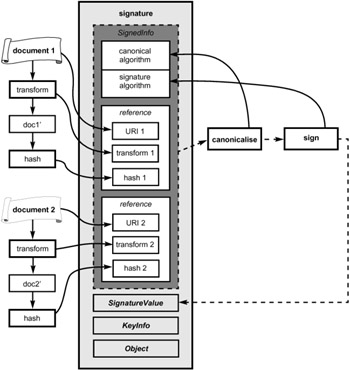
The second reason is flexibility XML signatures can refer to many documents or parts of a single document, as is required (Fig 2.7). Since the definition of what it is signing is contained within the signature, it is not limited to one case (usually the encapsulated message) as most signature protocols are. XML Signature is optimised for XML documents, but it can also be used to sign non-XML documents.
XML Signature makes use of a number of XML standards, including XML Schema to define its precise XML format, and XPath to identify nodes of the XML tree. For transformation purposes it refers...