The Lightning Flash

4.2: The ground flash

4.2 The ground flash

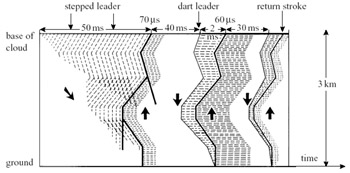
As outlined in Chapter 1, a thundercloud generally contains two main charge centres, one positive and the other negative, and a small positive charge pocket located at the base of the cloud. A ground flash occurs between the charge centres of the cloud and the ground. When a ground flash brings positive charge down to earth it is called a positive ground flash and when it brings negative charge it is called a negative ground flash. Time-resolved luminous features of a lightning flash as would be recorded by a streak camera are shown in Figure 4.1.


Figure 4.1: Time resolved luminous features of a lightning flash as would be recorded by a streak camera. The time increases from left to right. The time scale has been distorted for clarity (adapted from [10] and [169])

Electromagnetic field measurements show that a ground flash is initiated by an electrical breakdown process in the cloud called the preliminary breakdown. This process leads to the creation of a column of charge called the stepped leader that travels from cloud to ground in a stepped manner. Some researchers use the term preliminary breakdown to refer to both the initial electrical activity inside the cloud and the subsequent stepped leader stage.

On its way towards the ground a stepped leader may give rise to several branches. As the stepped leader approaches the ground the electric field at ground level increases steadily. When the stepped leader reaches a height of about...

UNLIMITED FREE
ACCESS
TO THE WORLD'S BEST IDEAS

SUBMIT
Already a GlobalSpec user? Log in.

This is embarrasing...

An error occurred while processing the form. Please try again in a few minutes.

Customize Your GlobalSpec Experience

Category: Protective Relays and Monitoring Relays
Finish!
Privacy Policy

This is embarrasing...

An error occurred while processing the form. Please try again in a few minutes.