The Lightning Flash

4.3: The cloud flash

4.3 The cloud flash

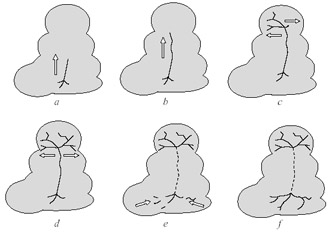
Cloud flashes normally occur between the main negative and upper positive charge of the cloud. Most of the information available today on the mechanism of the cloud flash is based on electric field measurements. More recently, Proctor [1 3] and Krehbiel and coworkers [4 6] made important discoveries utilising VHF radio imaging techniques (see section 4.11). The following picture of the cloud flash is based on the observations of Krehbiel and his coworkers (Figure 4.2):


Figure 4.2: Mechanism of a cloud flash. The cloud flash commences with a movement of negative discharges from the negative charge centre towards the positive one in a more or less vertical direction. This is the initial stage (a and b). This stage is followed by an active stage in which horizontal extension of the upper level channels takes place while charge is being transported from the lower level to the upper level along the vertical channel (c and d). In the latter part of this active stage significant extensions of the lower level channels take place but the extensions take place retrogressively (e). In the final stage the conductivity of the vertical channel decreases and the upper level channels will be cut off from the low level channels (f). The arrows indicate the general direction of the discharge development
  1. The cloud flash commences with a movement of negative discharges from the negative charge centre towards the positive centre in a more or less vertical direction.

    The vertical channel develops within...

UNLIMITED FREE
ACCESS
TO THE WORLD'S BEST IDEAS

SUBMIT
Already a GlobalSpec user? Log in.

This is embarrasing...

An error occurred while processing the form. Please try again in a few minutes.

Customize Your GlobalSpec Experience

Category: Powder Coating Equipment
Finish!
Privacy Policy

This is embarrasing...

An error occurred while processing the form. Please try again in a few minutes.