Optical Networks: A Practical Perspective, Second Edition

The authoritative source for information on optical networking technologies and techniques.
 TABLE OF CONTENTS
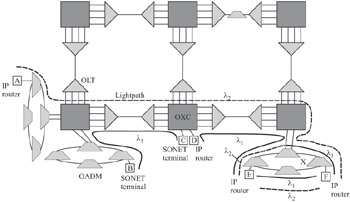
 We Have Already Explored some of the motivations for deploying WDM networks in Chapter 1 and will go back to this issue in Chapter 13. These networks provide circuit-switched end-to-end optical channels, or lightpaths, between network nodes to their users, or clients. A lightpath consists of an optical channel, or wavelength, between two network nodes that is routed through multiple intermediate nodes. Intermediate nodes may switch and convert wavelengths. These networks may thus be thought of as wavelength-routing networks. Lightpaths are set up and taken down as dictated by the users of the network.
In this chapter we will explore the architectural aspects of the network elements that are part of this network. The architecture of such a network is shown in Figure 7.1. The network consists of optical line terminals (OLTs), optical add/drop multiplexers (OADMs), and optical crossconnects (OXCs) interconnected via fiber links. Not shown in the figure are optical line amplifiers, which are deployed along the fiber link at periodic locations to amplify the light signal. In addition, the OLTs, OADMs, and OXCs may themselves incorporate optical amplifiers to make up for losses. As of this writing, OLTs are widely deployed, and OADMs are deployed to a lesser extent. OXCs are just beginning to be deployed.