Power Electronics and Motor Drives: Advanced and Trends

NEEDS BULKY IRON-CORED DC LINK INDUCTANCE
PROBLEMS OF COST, SIZE, WEIGHT AND LOSS
NEEDS DEVICES WITH SYMMETRIC BLOCKING CAPABILITY
LOAD IMPEDANCE DOES NOT AFFECT THE LOAD CURRENT WAVE
FOR PWM OPERATION, ONE SIDE SHOULD BE CAPACITIVE AND OTHER SIDE INDUCTIVE. FOR PHASE CONTROL, BOTH SIDES CAN BE INDUCTIVE
SLOW DYNAMIC RESPONSE
CONVERTER SYSTEM IS INHERENTLY REGENERATIVE WITH 4-QUADRANT DRIVE CAPABILITY
INABILITY TO OPERATE AT NO-LOAD CONDITION
PARALLEL CONVERTER OPERTION IS DIFFICULT
MORE RUGGED AND RELIABLE OPERATION NO SHOOT-THROUGH PROBLEM
SIMPLER FAULT PROTECTION
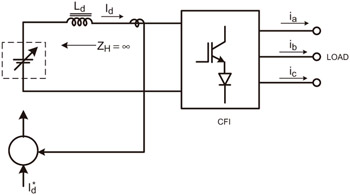
The PWM current-fed inverter requires a dc current source as indicated in the figure. The current source can be generated from a variable dc voltage source (via a dc-dc converter from dc voltage or phase-controlled rectifier from ac voltage) by feedback control of dc current. The salient features of current-fed converters (inverters or rectifiers) are summarized in this figure. The phase-controlled converters discussed in Chapter 3 also fall in this class. The power devices that are reverse blocking, such as thyristors, GTOs, IGCTs, or IGBTs, with a series blocking diode can be used. The other features will be evident later.
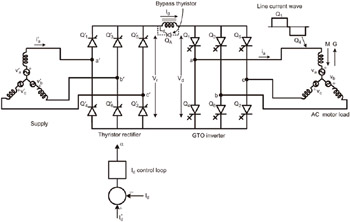
The figure shows a general power circuit for a three-phase current-fed inverter that uses reverse or symmetric blocking GTO devices. The inverter operates in square-wave mode to generate six-step (or six-pulse) current wave to the load. The load is shown as an equivalent circuit of induction or synchronous motor, which is represented...