Power Electronics and Motor Drives: Advanced and Trends

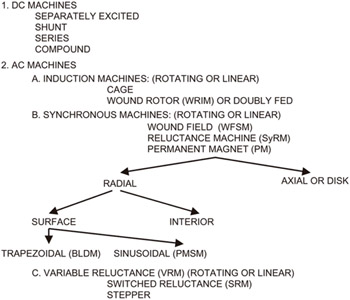
An electrical machine is the workhorse in a variable-speed drive system, and its function is to convert electrical energy into mechanical energy in various industrial applications. A machine can also operate as a generator to convert mechanical energy into electrical energy. In industrial drives, generator operation permits use of the regenerative braking mode, by which the machine speed slows down while its mechanical energy is recovered. Generally, machines can be classified as dc and ac machines. Traditionally, ac machines, particularly induction motors, have been used in constant-speed applications, whereas dc machines were used in variable-speed applications. Chapter 3 discussed phase-controlled dc drives, whereas Chapter 4 included brief descriptions of dc drives fed by dc-dc converters. AC machines, particularly induction and synchronous machines, will be discussed comprehensively in this chapter, and variable-speed drives with these machines will be treated in Chapters 7 and 8, respectively. Electrical machines constitute a vast and complex subject. But an engineer designing a high-performance drive must have thorough knowledge of machines. The primitive machines, since their invention more than a century ago, have gone through a process of continuous evolution to achieve the goals of cost, size, and performance, and this evolution will continue into the future.
HIGH COST, VOLUME, AND WEIGHT
HIGH INERTIA
LOWER EFFICIENCY
RELIABILITY AND MAINTAINABILITY PROBLEM
EMI PROBLEM
LIMITED HIGH SPEED
CANNOT OPERATE AT HIGH ALTITUDE
CANNOT OPERATE IN DIRTY AND EXPLOSIVE ENVIRONMENT
INHERENTLY FAST TORQUE RESPONSE
SIMPLE CONVERTER AND CONTROL
HAVE BEEN POPULAR...