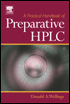
A Practical Handbook of Preparative HPLC
The importance of this mode of separation lies in the shear scale of the market for optically pure molecules. The sales of single enantiomer chiral drugs is currently U$180 billion per annum and 65% of active pharmaceutical ingredients (APIs) currently in development have at least one chiral centre. Apart from the pharmaceutical industry there is also considerable potential in the chiral agrochemicals market.
Chiral purity is generally introduced in one of three ways:
chiral purification
asymmetric chemistry
biotransformation.
In order to fully explain chiral chromatography it is necessary to have an understanding of chirality itself. It is worth describing how chiral separations work in order to help to dispel some of the myths surrounding the complexity of this mode of separation. A few brief definitions and formulae required to understand the summary are listed below.
A chiral object cannot be superimposed on its mirror image whilst an achiral object can be superimposed on its mirror image. The two forms of a chiral molecule are known as enantiomers. A single chiral isomer is said to be enantiomerically or optically pure. Whereas an equimolar mixture of enantiomers is said to be racemic.
The central point of chirality in a molecule is known as the stereo-centre and diastereoisomers occur when there is more than one stereo-centre in a molecule. Stereo-centres are given the absolute configurations of Rectus (R) and Sinister (S). Diastereoisomers that differ in absolute configuration at...