Steels: Microstructure and Properties, Third Edition

Examination of the time-temperature-transformation (TTT) diagram for an eutectoid carbon steel (Fig. 3.5), bearing in mind the fact that the pearlite reaction is essentially a high temperature one occurring between 550 C and 720 C and that the formation of the martensite is a low-temperature reaction, reveals that there is a wide range of temperature 250 550 C within which neither of these phases forms. This is the region in which fine aggregates of ferrite plates (or laths) and cementite particles are formed. The generic terms for these intermediate structures is bainite, after Edgar Bain who with Davenport first found these structures during their pioneering systematic studies of the isothermal decomposition of austenite. Bainite also occurs during athermal treatments at cooling rates too fast for pearlite to form, yet not rapid enough to produce martensite.
The nature of bainite changes as the transformation temperature is lowered. Two main forms can be identified: upper and lower bainite.
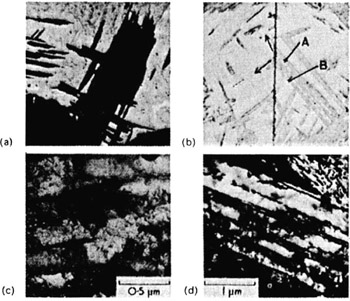
The microstructure of upper bainite consists of fine plates of ferrite, each of which is about 0.2 ?m thick and about 10 ?m long. The plates grow in clusters called sheaves. Within each sheaf the plates are parallel and of identical crystallographic orientation, each with a well-defined crystallographic habit. The individual plates in a sheaf are often called the sub-units of bainite. They are usually separated by low-misorientation boundaries or by cementite particles (see Fig. 6.1).