Steels: Microstructure and Properties, Third Edition
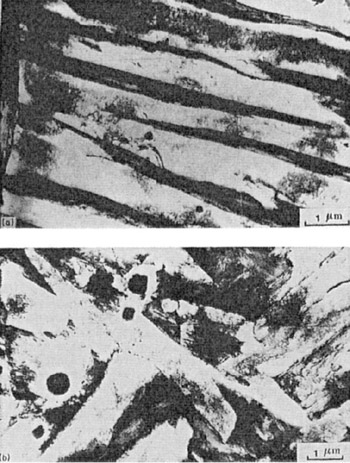
Highly organized microstructures can often be found in steels, e.g., ferrite can grow in the form of packets containing parallel plates which are in the same crystallographic orientation (Fig. 7.1a). This can be harmful to mechanical properties because cleavage cracks, or deformation processes, can extend readily across the packets. The effects of the individual plates within these packets then have a minimal effect on the mechanical properties.
Some of the most exciting recent developments in wrought and welded steel technology have involved acicular ferrite . Far from being organized, this microstructure is better described as chaotic. The plates of acicular ferrite nucleate heterogeneously on small non-metallic inclusions and radiate in many different directions from these point nucleation sites (Fig. 7.1b). It is believed that propagating cleavage cracks are frequently deflected as they cross an acicular ferrite microstructure with its many different orientations. This gives rise to superior mechanical properties, especially toughness.
Acicular ferrite is therefore widely recognized to be a desirable microstructure. This chapter deals with the mechanism by which it forms and with the role of inclusions in stimulating its formation.
The term acicular means shaped and...