Structure, Properties, and Applications of Various Alloys

This handbook explains the classification, purpose, preparation, and industrial applications of alloys.
Combining several elements in different proportions forms an alloy. When an alloy consists of two components, it is called a binary alloy. An alloy with three components is a ternary alloy, and an alloy with four components is a quaternary alloy. The resulting metallic substance has properties that are significantly different from those of its components. Modifying the composition by 1% can change the property of one unit of an alloy system. Based on its formation, the alloy can be classified as:
Homogeneous alloy
Mixture or heterogeneous alloy
In a homogeneous alloy, the mixture consists of only one phase and a mixture alloy is a combination of several phases.
| Note | In solid chemistry, a mixture of multiple metals may exist in single phase. The type of phase depends upon the degree of mixibility of two metals. If the metals get completely mixed a homogeneous phase is formed otherwise a heterogeneous phase is formed. |
Figure 1-1 explains various phases of alloys based on their homogeneous or heterogeneous formation:
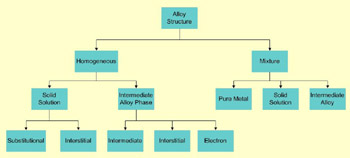

 TABLE OF CONTENTS