Bifurcations And Chaos In Piecewise-Smooth Dynamical Systems: Applications To Power Converters, Relay And Pulse-Width Modulated Control Systems, And Human Decision-Making Behavior
Chapter 3 outlined some of the problems associated with the study of complex dynamics in relay control systems. In this chapter we will perform a detailed bifurcation analysis of two different types of control systems that one can meet in real-world technical applications. The aim is to investigate the structure of the two-parameter diagram of dynamical modes and to examine the regularities in the occurrence of periodic cycles. We shall also determine the main bifurcations and analyze the nature of the transitions to chaotic dynamics. Even though engineering practice at the present may not comply with such a standard, analyses of this type are required in the design of a wide variety of modern control systems.
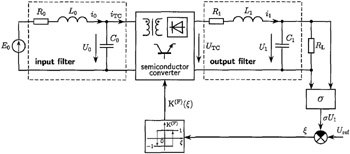
As a first example we shall consider a constant voltage converter with relay control whose behavior is described by equations of the form (3.7). The equivalent circuit of this converter is depicted in Fig. 4.1. The power part of the circuit comprises a transistor converter of constant voltage working in switch mode, a transformer-rectifier device, and a couple of ripple LC-filters (see, e.g. [1, 2, 3]). The feedback signal ?, carrying information about the deviation of the output voltage U 1 from its prescribed value U ref, is applied to a relay element with hysteresis, in order to form the square pulses (see, e.g. Fig. 3.1(b)) used to control the switching elements of the transistor converter.