3.2.1.1 The Nernst equation
For a typical chemical equation with non-charged species,
| (1) | 
|
the free energy of the reaction is simply the difference between the chemical potentials of the products and reactants (as shown below).
| (2) | 
|
At equilibrium, ?G=0 and since the chemical potential of any species can be defined by:
| (3) | 
|
where is the standard chemical potential, R the gas constant, T the temperature and M either the fugacity or activity of the substance, equation (2) can be expressed as:
which can be rearranged as:
or
| (4) | 
|
where ?G ? is the standard Gibbs free energy of reaction and K is the equilibrium constant.
However, in electrochemical reactions, at least one species will carry a charge. In this case, it is necessary to add an additional term to the chemical potential to represent the electrical free energy (due to the interaction of the charge with its environment). This yields the electrochemical potential which is defined as:
| (5) | 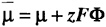
|
where z is the charge number (including sign, i.e., ?1 for an electron), F is Faradays constant (96485 C mol ?1), and ? the Galvani potential.
Now consider a typical electrochemical reaction in which an electron is transferred from a metal electrode into the solution. There it reduces an oxidized species (O) to a reduced species (R) where one (or both) of which must be charged:
| (6) | 
|
Once again, ?G must be zero at equilibrium. This means...


 TABLE OF CONTENTS