A First Systems Book: Technology And Management , 2nd Edition
We recognize four levels of measurement:
| 1 | direct measures, perceived by our senses, |
| 2 | derived from these, indirect measures, |
| 3 | object-centred measures a collection of direct or indirect measures pertaining to a particular referent, |
| 4 | utility measures measures which incorporate both the object-centred measures and the value judgement of the evaluator. |
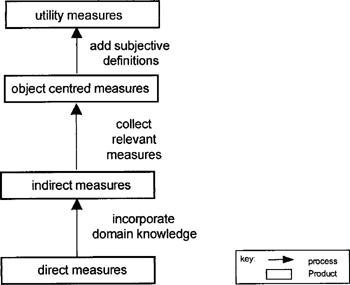
These four types of measures form levels of the measurement hierarchy shown in figure 5.2.
Values for individual attributes of an entity may be obtained directly by inspection, by comparison with a standard, or by use of instrumentation.
The teacher compares two children by eye to determine which is the taller, or measures the height of each child with the aid of a yardstick.
The mother dips her elbow into the baby's bathwater, measuring temperature directly by comparing the water temperature with her own body temperature, or measures it by use of a thermometer.
The chef measures the strength of chili pepper by his palate's reaction to it.
Acidity is tested by noting by the colour of Universal indicator as a measure of pH.
Concentration of methane in a coalmine used to be observed through the behaviour of a canary in a cage, and later by inspection of a Davey lamp.
We can now begin to construct our hierarchy of measures. Direct measures form the base of the hierarchy shown in figure 5.2.
Characteristics not readily available for...