Intelligent Watermarking Techniques

Chin-Shiuh Shieh, Hsiang-Cheh Huang, Zhe-Ming Lu, and Jeng-Shyang Pan
Vector quantization had been distinguished for its high compression rate in lossy data compression applications. To be of practical significance, a digital watermarking technique should take into account the effect of vector quantization compression. In this chapter, we will review two important streams of watermarking techniques based on vector quantization. In one of them, embedded information is implicitly carried in the codeword indices. In the other, signature binding together the watermark and the original image was generated for certification purpose. Some discussions on possible extensions to existing approaches are given at the end of this chapter.
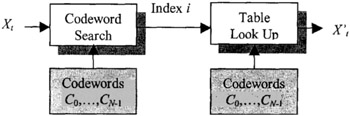
To reduce the space requirement for storage and the bandwidth requirement for communication, wide variety of compression techniques had been developed (Sayood 2000). For multi-media applications, less significant information can be sacrificed for higher compression rate, since human sensory system is less sensitive to detail information. In this kind of applications, vector quantization (Gersho et al. 1992) had received considerable attention for its high compression rate and its essential role in various compression applications. As an extension to scalar quantization, vector quantization works on vectors of raw data. A vector can be fixed number of consecutive samples of audio data or a small block of image/video data for example, the gray-level values of a 4 4 pixel image block forms a 16-dimentional vector. Figure 1 gives an illustration of the operation of vector quantization compression.