Nanostructures And Nanomaterials: Synthesis, Properties & Applications

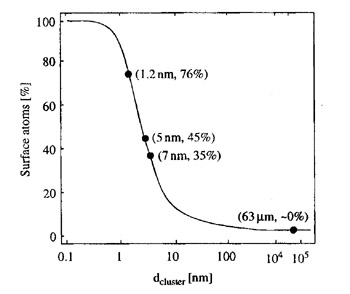
Nanostructures and nanomaterials possess a large fraction of surface atoms per unit volume. The ratio of surface atoms to interior atoms changes dramatically if one successively divides a macroscopic object into smaller parts. For example, for a cube of iron of 1 cm 3, the percentage of surface atoms would be only 10 ?5%. When the cube is divided into smaller cubes with an edge of 10 nm, the percentage of the surface atoms would increase to 10%. In a cube of iron of 1 nm 3, every atom would be a surface atom. Figure 2.1 shows the percentage of surface atoms changes with the palladium cluster diameter. [1] Such a dramatic increase in the ratio of surface atoms to interior atoms in nanostructures and nanomaterials might illustrate why changes in the size range of nanometers are expected to lead to great changes in the physical and chemical properties of the materials.
The total surface energy increases with the overall surface area, which is in turn strongly dependent on the dimension of material. Table 2.1 indicates how the specific surface area and total surface energy of 1 g of sodium chloride vary with particle size. [2] The calculation was done based on the following assumptions: surface energy of 2 10 ?5