6.5 Prolate spheroids; spheroidal multipole expansions
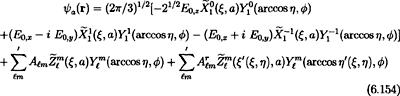
The solution of the problem for a prolate spheroid, see fig. 6.6, runs along the same lines as the one given in the previous section for an oblate spheroid. Consider the response in a constant electric field E 0 = ( E 0, x, E 0, y, E 0, z). The corresponding incident potential is now written as
where the definitions, eqs. (6.5), (6.6), (6.8), (6.58), (6.53) and (6.55), of the functions Y m ? and  have been used and where prolate spheroidal coordinates ?, ? and ?, defined by eqs. (6.48) and (6.49) (or the inverse transformation eq. (6.50)) have been introduced. The general solution in the ambient may be written, in complete analogy with the corresponding expression for an oblate spheroid, as a sum of the incident potential, the potential due to the charge distribution, induced in the island, and the image charge distribution in the substrate:
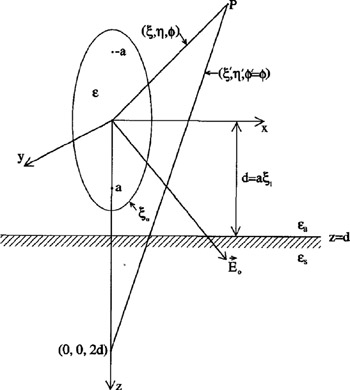 Figure 6.6: A prolate spheroid above a substrate.
 Here ? ? and ? ? are the first two prolate spheroidal coordinates of the point ( x, y, z) in the shifted coordinate frame with origin at (0,0,2 d), see fig. 6.6. The functions  are defined by eqs. (6.59), (6.54) and (6.55). For the potential in the substrate one may write similarly
It can be verified that eqs. (6.101)-(6.106), given in the previous section, remain valid also for prolate spheroids.
The potential...


 TABLE OF CONTENTS