Optical Properties of Surfaces, Second Edition

In this chapter expressions will be derived for the angle of incidence dependent reflection and transmission amplitudes in terms of the seven electromagnetic interfacial constitutive coefficients introduced in the previous chapter. For non-magnetic systems the resulting reflectances, transmittances as well as ellipsometric coefficients are given. Contrary to the amplitudes these quantities are measurable and therefore independent of the choice of the dividing surface. They can therefore be expressed in terms of the invariants introduced in the previous chapter. The expressions in terms of these invariants are given.
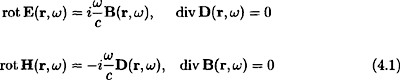
The media on both sides of the surface are chosen to be homogeneous and isotropic. The radiation field in these media is a solution of the Maxwell equations, cf. eq. (3.24),
The constitutive equations are
where ? and ? are the frequency dependent dielectric constant and magnetic permeability. If one calculates the rotation of the first Maxwell equation, and uses the second and the third Maxwell equation together with the constitutive relations one obtains the wave equation
Here ? is the Laplace operator
Furthermore the refractive index of the medium is identified with
If there is absorption in the medium n( ?) will be a complex function of ?. This is the consequence of the fact that either the dielectric constant or the magnetic permeability are complex functions of ?. In that case the plane wave solution will decay exponentially in the direction of propagation. Its source must be at a finite distance of...