Planar Graph Drawing

Chapter 2: Graph Theoretic Foundations

2.1 Basic Terminology

In this section we give some definitions of standard graph-theoretical terms used throughout the remainder of this book.

2.1.1 Graphs and Multigraphs

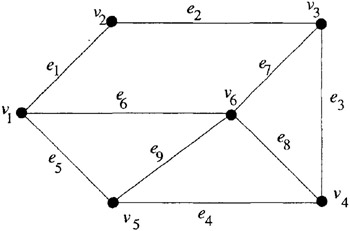
A graph G is a tuple (V, E) which consists of a finite set V of vertices and a finite set E of edges; each edge is an unordered pair of vertices. We often denote the set of vertices of G by V(G) and the set of edges by E(G). Figure 2.1 depicts a graph G, where each vertex in V(G)={ ? 1, ? 2, , ? 6} is drawn by a small black circle and each edge in E(G)={ e 1, e 2, , e 9} is drawn by a line segment. The number of vertices of G is denoted by n, that is, n=V, and the number of edges of G is denoted by m, that is, m= E. Thus n=6 and m=9 for the graph in Fig. 2.1.


Fig. 2.1: A graph with six vertices and nine edges.

If a graph G has no multiple edges or loops, then G is called a simple graph. Multiple edges join the same pair of vertices, while a loop joins a vertex itself. A graph in which loops and multiple edges are allowed is called a multigraph. In the remainder of the...

UNLIMITED FREE
ACCESS
TO THE WORLD'S BEST IDEAS

SUBMIT
Already a GlobalSpec user? Log in.

This is embarrasing...

An error occurred while processing the form. Please try again in a few minutes.

Customize Your GlobalSpec Experience

Category: Accelerometers
Finish!
Privacy Policy

This is embarrasing...

An error occurred while processing the form. Please try again in a few minutes.