The Principles of Semiconductor Laser Diodes and Amplifiers: Analysis and Transmission Line Laser Modeling

High-frequency limitations due to electrical parasitics have been analysed using lumped-element circuit models [ [35]]. At high frequencies, (in the GHz range), electrical parasitics cause a roll-off in the laser's modulation response. This means that the design of matching networks is affected as frequency increases. Therefore, when designing matching networks, the contribution of electrical parasitics should be taken into consideration.
Due to the incompatibility between non-circuit based numerical models of semiconductor lasers and electrical circuit networks, the laser parasitics and matching circuit designs are rarely considered. An exception to this is the TLLM, which can simulate the laser parasitics network based on TLM lumped elements [ [63]]. A two-port model with bidirectional interfaces for both electrical and optical ports was first proposed by Lowery [ [66]].
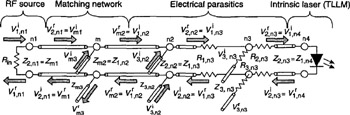
The electrical parasitics and matching network used in the integrated TLLM were modelled by TLM stub-lines and link-lines (see Chapter 14). The TLM representation of the electrical parasitics network of Fig. 15.19 is shown in Fig. 15.20. The equivalence between the lumped elements and TLM components (distributed elements) are also listed in Table 15.4.
| Lumped element | Equivalent TLM impedances |
|---|---|
| Stand-off shunt capacitance, C p | Z 3,n2 |
| Bondwire inductance, L p | Z 2,n2 = Z 1,n3 |
| Bondwire resistance, R p | R 1,n3 |
| Chip substrate resistance, R sub | R 3,n3 |
| Shunt parasitic... |