Thermochromic Phenomena in Polymers
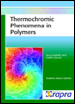
Structured by thermochromic material type, this review examines the state-of-the-art of existing as well as potential future applications based on specific material classes.
 TABLE OF CONTENTS
 A comparison between the classes of thermochromic additives presented in Sections 3.1 3.3 is given in Table 3.2. The outstanding property of organic thermochromic materials is that switching temperature and colour can be customised. Moreover, the narrow absorption band allows the creation of multiple switching effects by a combined use of several thermochromic additives. With a view to application, these properties are very important. They enable a flexible adjustment of the thermochromic properties for specific application. The advantage of inorganic pigments is their thermostability above 200 C and their light stability which is even suitable for outdoor application. However, most of the inorganic pigments for these applications are toxic.
| Material property | Inorganic pigments | Organic microcapsules | Conjugated polymers |
|---|---|---|---|
| Switching temperature | 70 500 C | 0 130 C | ? |
| Thermostability | Stability at 500 C possible | <200 C | <200 C |
| Light stability | Suitable for outdoor applications | Insufficient | Insufficient |
| Multiswitching between different colours possible? | Reversible: no; only two colours Irreversible: yes | Yes | No |
| Switching temperature adjustable? | Fixed transition temperatures | Switching temperature is adjustable | Fixed transition temperatures |
| Colour variable at constant switching temperature? | Fixed colours | Colour variable by changing dye component | Fixed colours |
| Toxicity | Toxic | Non-toxic | Non-toxic |