Accelerated Product Development: Combining Lean and Six Sigma for Peak Performance

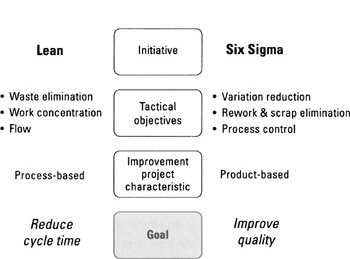
Up to now, the lean concepts and tools discussed have focused heavily on reducing cycle time and cost. However, another key element, quality, is critical to achieving the goal of maximizing customer value related to product development. If you will remember Figure 1-3 (reproduced here as Figure 12-1), different tactical objectives and tools are required in order to improve quality. These objectives are focused primarily on variation reduction and process control.
Collectively, Manufacturing Process Control and Design for Six Sigma (discussed in Chapter 13) address the issue of improving product quality through the development process. Implementing these elements help answer the following questions:
Can the product be manufactured or assembled without any problems?
Does the product perform in accordance with the customer's specification?
Will the product meet the customer's expectation in terms of product reliability and durability?
Let's begin with an explanation of Manufacturing Process Control (MPC). MPC is a disciplined approach for assessing the variability of part features by analyzing measurement data derived during inspection of those features. The goal of minimizing variability is accomplished by controlling the process parameters that influence the manufacture of the part features. Based on this, MPC is most effective when it is implemented across a family of common parts with similar characteristics. Consequently, the same part families that are created for product development and leveraged in developing a supply chain strategy can also be used to improve product quality through...