The Advanced Communications Technology Satellite: An Insider’s Account of the Emergence of Interactive Broadband Services in Space

The battlefield is dynamic and mobile, as evidenced in the Gulf War. Providing the battlefield commander with updated intelligence, targeting, weather, and command information is vital. Operations require tactical commanders to operate independently. To date, communication capabilities that provide intelligence and command orders to such tactical units have been limited to simple voice and low rate, narrow-bandwidth communications.
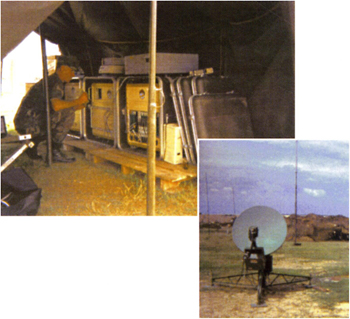
The Army Space Command spearheaded a number of Army organizations in the evaluation of ACTS to provide battlefield commanders with on- demand, wide-bandwidth, integrated services. Seven T1-VSATs were made more durable and designed to be highly transportable for tactical operations.
The primary objectives of the Army s program were to test and evaluate ACTS in multiple field exercises to realistically simulate battlefield communication requirements. In a number of operational field trials and demonstrations with tactical units, ACTS was used to provide on-demand, integrated voice, video, data between forward tactical units, and geographically dispersed rear echelon commands. The T1-VSATs provided local commanders with the ability to dictate the assignment of bandwidth for specific user services. Some of the many Army communications needs tested were:
video teleconferencing for command and control
reconnaissance imagery
integrated weather charts/imagery
mobile phone base station relay
telemedicine
logistical supply
video conferencing for morale boosting
interconnection into the Defense Commercial Telecommunications Network (DCTN) to provide a seamless satellite/terrestrial network
The Army used its seven T1-VSATs in support of Operation Uphold Democracy in...