The Advanced Communications Technology Satellite: An Insider’s Account of the Emergence of Interactive Broadband Services in Space

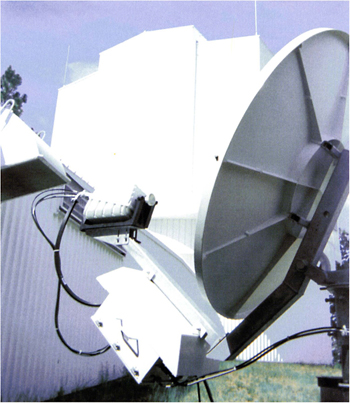
The 900 MHz bandwidth of the ACTS transponders provided a unique capability to handle data rates of hundreds of megabits per second, which are not available with today s conventional satellites. HDR earth stations were developed to exploit this capability and deliver 155 Mbps (OC-3) and 622 Mbps (OC-12) digital services. The use of SONET physical layer protocols allowed seamless interconnections with the terrestrial fiber network. ATM communications were easily run on top of this SONET structure.
This capability opened up a whole new range of applications associated with geographically distributed computing, especially those associated with high-speed workstations and supercomputers. Although supercomputers were once the domain of university and government researchers, additional nonresearch applications are growing such as the cancer dose treatment planning outlined in the section in this chapter on medical experiments. The satellite/terrestrial networking trials using ACTS provided the ability to make such supercomputers available on an on-demand, non-dedicated basis for those organizations and applications that don t require or can t afford a dedicated supercomputer. Such capability will provide more effective resource sharing and an improved utilization of computing resources.
Aeronautical Modeling The Boeing Commercial Airplane Group in Seattle, Washington, conducted a series of interactive, computational flow, dynamic simulations to develop an engine control system by remotely flying an engine model in a numeric wind tunnel [77]. The inlet simulation that was developed by Boeing was executed on the LeRC Cray supercomputer and controlled by the Boeing...