Advanced Drilling Solutions: Lessons from the FSU, Volume II

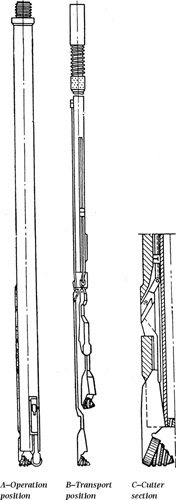
Subsequent to the development of rotary drilling and the increase of borehole depths, engineers developed the concept of decreasing drillstring round-trip time to change the worn bit. The principal answer was the development of a bit that could be run in and pulled out of the bottomhole inside the casing or drillpipe, using a wireline or drilling mud circulation. These bits were used in two situations: (1) bottomhole destruction and (2) transport for moving inside the pipe. The bit name, Retractable Bit (RB), is derived from these uses (Fig. 7-1).
Use of this tool allowed us to drill without pulling out the pipe (DWPP) and substantially affected the process of construction of a borehole or one of its intervals. The latter resulted from new DWPP features, such as:
continuous flushing of the borehole during the RB operational cycle: running in, drilling, pulling out
change of the different purpose tools (drilling, coring, and milling) without pulling out drillpipes
carrying out logging operations without pulling out drillpipes
relief of the workload on drilling rig crews
At the same time, the traditional method of bit rotation by stiff drillstring and/or DHM was maintained. It was natural that the advantages achieved required additional investment. Except for the more complicated bit design, the special or larger ID flush joint drillpipe was used. Actually, this was supposed to be a casing pipe application that introduced the real advantage of the RB technology simultaneous borehole casing and drilling. Unfortunately, the...