Advances in Bistatic Radar

Chapter 2: History Update

Nicholas J. Willis

2.1 BEGINNINGS

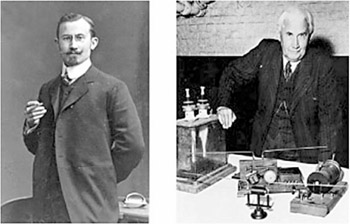
Radar was first patented and demonstrated in 1904 by the German engineer Christian H lsmeyer. As is well documented [2 5], his telemobilskop used a special spark-gap transmitter operating on a 40 50-cm wavelength and a separate receiver that rang a bell when detecting ships up to 5 km from the receiver. Figure 2-1 shows photographs of H lsmeyer and his invention.


Figure 2-1: Christian. The spark-gap transmitter is on the left; receiver, dipole antennas, and bell on the right. Left photo was taken in 1904; right photo, considerably later. The telemobilskop is now on display at the Deutsches Museum, Munich. Courtesy of University College, London.

The first fully documented demonstration of the telemobilskop was in Cologne, in May 1904, with both the transmitter and receiver located on a platform under the Rhine Bridge (a chain suspension bridge destroyed during World War II) in a monostatic configuration to detect ships on the Rhine River [5]. [2]

Purists might argue that H lsmeyer's telemobilskop was not a radar because it did not directly measure range, as in "radio detection and ranging," and technically they would be correct. However, his invention included the essential elements of a radar, all reduced to practice: antennas, transmitter, receiver (with adequate shielding), and indicator, in this case an audio alarm to signal when a target was sufficiently close in range to require attention. More sophisticated indicators would have to await the development of timing circuits and displays.

Now for an excursion to...

UNLIMITED FREE
ACCESS
TO THE WORLD'S BEST IDEAS

SUBMIT
Already a GlobalSpec user? Log in.

This is embarrasing...

An error occurred while processing the form. Please try again in a few minutes.

Customize Your GlobalSpec Experience

Category: Antennas
Finish!
Privacy Policy

This is embarrasing...

An error occurred while processing the form. Please try again in a few minutes.