Advances in Bistatic Radar

Joshua Wurman and Nicholas J. Willis
Accurate knowledge of the full, three-dimensional vector wind field throughout a volume of the atmosphere is useful for aviation, weather forecasting, and research. Specifically, spatially and temporally resolved wind field data can be used to improve (a) prediction of hazardous aviation events, including economically costly wind shifts; (b) general weather forecasting, including weather hazards; (c) mesoscale modeling (modeling of meteorological phenomenon approximately 1 100 km in horizontal extent); (d) media weather presentations; and (e) research into boundary layer fluxes, convective dynamics, and thunderstorm electrification.
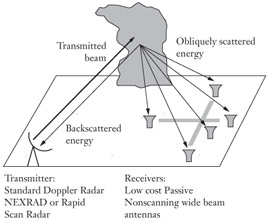
A bistatic doppler weather radar network is one method of retrieving these vector wind fields. It consists of one monostatic doppler weather radar and one or more remote bistatic receivers, or bistatic network receivers (BNRs), each having a nonscanning, low-gain, passive antenna. A single monostatic radar and single BNR measures the two-dimensional (horizontal) vector wind field by using the dual-doppler technique, which is a synthesis of doppler velocity vectors from two separated radars, in this case one from the monostatic radar and one from the BNR. When two or more BNRs hitchhike off a monostatic doppler weather radar, a triple- or multiple-doppler technique can be used to retrieve full, three-dimensional vector wind fields. Figure 8-1 is a schematic of a typical network near an airport.