4.8 Spray and Adiabatic Cooling
The performance of air-cooled heat exchangers can be enhanced by spraying droplets of water directly onto a part of the air-side heat transfer surface or into the airstream approaching the heat exchanger. Spray droplets may be quite large and cause significant wetting of the heat transfer surface, or they may be quite small mist resulting in the formation of a thin water film where wetting does occur according to Finlay, Sen, Simpson, Yang, Hayashi, Nakayama, Dreyer, and Lee.
If the water is introduced into the inlet airstream of an air-cooled heat exchanger or dry-cooling tower as a very fine spray or mist and all droplets evaporate before reaching the heat exchanger, the effective drybulb temperature of the air is reduced. At the same time, the humidity increases as the water evaporates. For all practical purposes, the ambient air is cooled following the line of constant wetbulb temperature from its original state at 1 to the final state at 2, i.e., T wb2 = T wb1, shown on the psychromatic chart (Fig. 4.8.1) according to Stoecker.
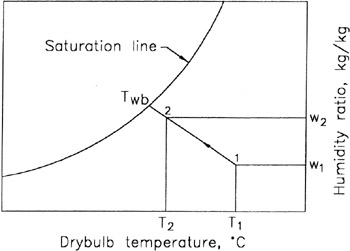 Figure 4.8.1: Adiabatic Cooling
 The spray may be introduced into the airstream at a fixed or variable rate depending on the system requirements. The particular ambient temperature at which the spray is switched on depends on the ultimate total cost of the spray relative to the cost of the product delivered by the plant, e.g., power, chemical substance, etc.
The spray may be introduced at such a...

 TABLE OF CONTENTS