Air-Cooled Heat Exchangers and Cooling Towers: Thermal-Flow Performance Evaluation and Design, Volume 1

4.9: Visible Plume Abatement

4.9 Visible Plume Abatement

Saturated or supersaturated discharge air or plume rising from a wet-cooling tower is further cooled as a result of a natural temperature lapse and mixing with the ambient air. This cooling causes more water vapor in the plume to condense and form small water droplets that make up the visible plume. On rising, the evaporation of droplets from the edge of the plume further increases the tempo and amount of cooling and droplet formation. The plume may become denser than the atmospheric air, and as it moves downward, it edges towards the ground. At this stage the plume can become a visibility hazard, especially if there are highways or airports nearby. Icing of roads and landing strips may occur. Corrosion of steel and other structures may also be a problem, while visible pollution and shading caused by the plume may be unacceptable.

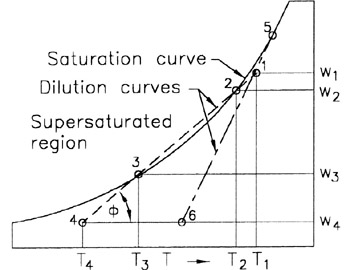
The various stages in the formation of a plume can be illustrated on a psychrometric chart (Fig. 4.9.1).


Figure 4.9.1: Plume States

Assume the plume air is initially at the state represented by point 1 on the psychrometric chart, and the cool or winter ambient air is at the state represented by point 4. As the plume rises and mixes with the colder ambient air, it may follow a line 1 4 (dilution line). At point 2, condensation of vapor commences, and the plume becomes visible and will remain so until the state 3 is reached. At this point, the plume will become invisible.

UNLIMITED FREE
ACCESS
TO THE WORLD'S BEST IDEAS

SUBMIT
Already a GlobalSpec user? Log in.

This is embarrasing...

An error occurred while processing the form. Please try again in a few minutes.

Customize Your GlobalSpec Experience

Category: Scrubbers
Finish!
Privacy Policy

This is embarrasing...

An error occurred while processing the form. Please try again in a few minutes.