Aircraft Engines and Gas Turbines, Second Edition
The feature that distinguishes compressors and turbines from the fixed aerodynamic components of the engine and the aircraft is the energy exchange between rotor and fluid, which makes possible the compression and expansion required for an efficient thermal cycle. Because this process of dynamic energy exchange used in all turbomachines is not discussed in the usual courses and texts in fluid mechanics, it will be discussed first from a fundamental viewpoint.
We begin with the first law of thermodynamics in the form
where e is internal energy, w is mechanical work, and ? is the density. (Note that the energy and work are specific quantities, i.e. per unit mass.) In the inviscid limit considered here, no forces (other than the normal forces represented by p) act on the fluid, so ? w = 0. If we consider the differentials of e and 1/ ? to be taken following an element of the fluid as it moves, the first law becomes
| (5.1) | |
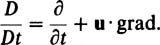
where
The second fundamental law is the momentum equation for the fluid. Because the force acting on the fluid per unit volume is the gradient of the pressure, Newton's second law takes the form
| (5.2) | |
(Representing the fluid acceleration by D u/Dt is valid only if the velocity u is referred to an inertial coordinate system.)
Forming the scalar product of equation 5.2 with u gives the following expression for the...