Aircraft Engines and Gas Turbines, Second Edition
5.9: Supersonic-Throughflow Fan

5.9 Supersonic-Throughflow Fan

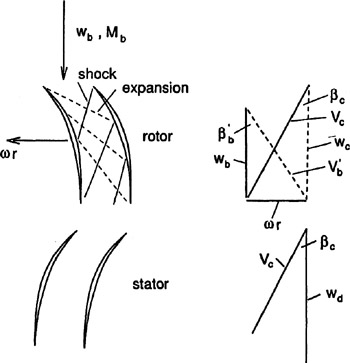
At its design point, the supersonic-throughflow fan would operate with supersonic axial velocity throughout the flow path (that is, the flow would be supersonic in both absolute and rotor-relative coordinates). For a design such as that shown schematically in figure 4.27, the Mach number at the fan face might be 2 or a bit less for a flight Mach number of 2.4. As indicated in figure 5.45, the flow is turned toward the axial direction in the rotor; since the flow area expands, the pressure drops and the flow is accelerated relative to the rotor. The flow is also supersonic relative to the stator, which also turns toward the axis to remove the swirl imparted by the rotor and so also has increasing flow area and dropping pressure. Thus we have a "compressor" which adds energy to the flow while lowering the static pressure. This can result in a useful fan design because of the compression in the inlet ahead of the fan. In principle at least, it affords the advantage of lower diffusion requirements in the blade passages than for a subsonic stage of comparable work; in addition, it offers a reduction of shock losses, since the flow does not have to be diffused to subsonic conditions at any point in the stage.


Figure 5.45: Blade shapes and velocity triangles for a supersonic-throughflow fan.

In this respect the supersonic-throughflow fan differs fundamentally from early supersonic compressors, in which the rotor was conceived to operate with fully...

UNLIMITED FREE
ACCESS
TO THE WORLD'S BEST IDEAS

SUBMIT
Already a GlobalSpec user? Log in.

This is embarrasing...

An error occurred while processing the form. Please try again in a few minutes.

Customize Your GlobalSpec Experience

Category: Wind Tunnel Testing Services
Finish!
Privacy Policy

This is embarrasing...

An error occurred while processing the form. Please try again in a few minutes.