American Electricians' Handbook, Fourteenth Edition

Filled with practical advice and facts, this definitive resource provides essential information on designing, installing, operating, and maintaining electrical systems and equipment.
 TABLE OF CONTENTS
 1. Explanation of light. Light ( Standard Handbook for Electrical Engineers) may be defined as radiant energy of those wavelengths to which the human eye is sensitive. Figure 10.1 shows the complete radiant-energy spectrum of electromagnetic waves, which travel through space at the velocity of approximately 186,000 mi/s. The longer waves are the ones used in radio communications; the shortest ones are the x-rays and cosmic rays. The waves to which the eye is sensitive are those near the middle of the spectrum, of a length of about 0.0004 to 0.0008 mm. An enlarged section of this part of the spectrum is shown in the figure.
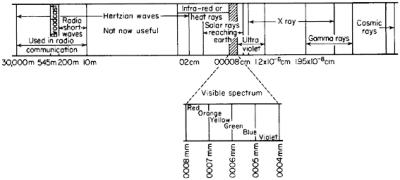
The effect of light upon the eye gives us the sensation of sight. The impression of color depends upon the wavelength of the light falling upon the eye. There are three primary colors of light: red, green, and violet. Violet light has the shortest wavelength of the radiant energy to which the eye is sensitive, red the longest, and green an intermediate wavelength between those of violet and red. These three colors are called the primary colors, because light of any one of them cannot be produced by combining light of any other colors. Light of any other color than these three can be produced by combining in the proper proportions light of two or all three of the primary colors.
2. Propagation of light. Rays of light travel in straight lines...