Analytical Ultracentrifugation: Techniques and Methods

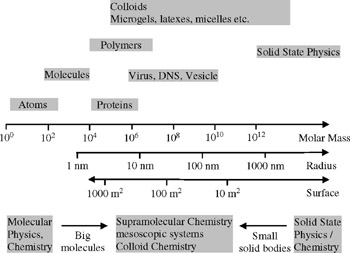
Colloidal systems are systems characterized by mesoscopic size dimensions as visualized in Figure 2.
Colloids have special properties owing to their sizes between the atomic and the macroscopic range, and the most important colloid property is the size. As proteins, polymers, DNA, etc. can be considered special cases of colloids, it becomes clear that the analysis of colloids, with all of its associated questions, is even more complex than that of macromolecules. Consequently, AUC of colloids differs in many respects from that of polymeric systems; therefore special emphasis is placed on the following problems and their solutions in this chapter:
Colloids may exhibit extremely broad particle size distributions and associated sedimentation coefficient distributions. The danger of this is that big aggregates or small impurities are not detected.
Colloids can aggregate or grow during centrifugation (concentration-dependent aggregation).
Density of hybrid colloids is often unknown and hinders calculation of particle size.
Electrostatic stabilization complicates analysis owing to charge contributions.
Particle polydispersity in size, shape, density, and hydration.
High particle density often makes density gradient or density variation methods impossible.
Colloids are often multicomponent mixtures.
Some of these problems can be effectively addressed by AUC, whereas others are more difficult or even impossible to solve by AUC or any other currently available method alone. For example, one property of many colloidal systems (especially those of inorganic nature) is their very small particle size <10 nm. Whereas light scattering commonly fails...