Biophysical and Structural Aspects of Bioenergetics

Chapter 6: The bc1 Complex What is There Left to Argue About?

Antony R. Crofts,
Department of Biochemistry, University of Illinois at Urbana-Champaign, 419 Roger Adams Lab, 600 S. Mathews Avenue, IL 61801,
Urbana

1 Introduction

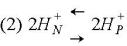
The cytochrome bc 1 complex and its relatives are the central enzymes of respiratory and photosynthetic chains, and catalyze the oxidation of hydroquinones in the membrane by small mobile aqueous redox proteins. The redox work is coupled to transfer of protons across the membrane. For the bc 1 complex, which oxidizes ubihydro-quinone (quinol, QH 2), the reaction equations can be written to represent the overall reaction by its scalar and vectorial components:


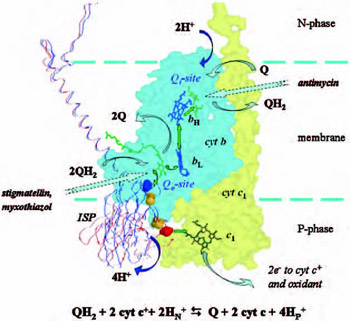
The mechanism through which this overall reaction is accomplished has been the subject of extensive work from many labs, which has led to a consensus represented by a modified Q-cycle [1], [2], [3] (Figure 1, see [4] for a historical review). The mechanism appears at first sight to be so complicated as to discourage detailed physicochemical description. As the structures have shown, [5], [6], [7], [8] the three catalytic subunits contain five catalytic interfaces, three of them concerned with processing external substrates, and these are connected through two separate-electron transfer chains. The complex is a homodimer, and much speculation about interaction between monomers has opened the possibility of even higher levels of complexity. [7], [9], [10], [11], [12], [13], [14]


Figure 1: The modified Q-cycle shown in the context the structure. The three catalytic subunits of a...

UNLIMITED FREE
ACCESS
TO THE WORLD'S BEST IDEAS

SUBMIT
Already a GlobalSpec user? Log in.

This is embarrasing...

An error occurred while processing the form. Please try again in a few minutes.

Customize Your GlobalSpec Experience

Category: Catalysts and Initiators
Finish!
Privacy Policy

This is embarrasing...

An error occurred while processing the form. Please try again in a few minutes.