Broadband Communications and Home Networking

10.4: Geostationary Orbits

10.4 Geostationary Orbits

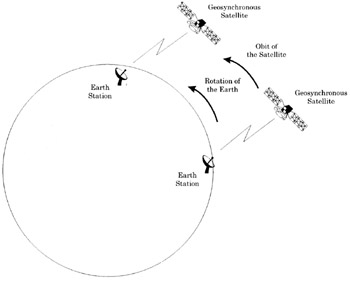
Most communication satellites are approximately 22,000 miles above the earth surface. They generally follow a circular orbit on the equatorial plane, circling the earth once every twenty-four hours. By synchronizing the satellite to the earth s rotation, so that the satellite follows the earth at approximately the same speed as the angular rotation of the earth, the satellite will look stationary to a fixed point on the earth (see Figure 10 4).


Figure 10 4: Geostationary satellite orbit.

This setup provides a continuous link with a given satellite at any time during the day or night. Therefore, the communication link will be available all the time, unless there is a problem with the data link between the earth and the satellite. Another advantage is that the ground equipment becomes less expensive and easier to operate, since tracking a reasonably stationary satellite is much easier than tracking a satellite with high angular velocity.

Although geostationary satellites appear stationary, the satellite actually drifts in a figure 8 pattern north and south of the equator. Satellites are designed to help mitigate this drift, so that the earth stations can be stationary without automatic tracking controls. After these satellites are in orbit for close to space lives, then this figure 8 pattern becomes much larger.

UNLIMITED FREE
ACCESS
TO THE WORLD'S BEST IDEAS

SUBMIT
Already a GlobalSpec user? Log in.

This is embarrasing...

An error occurred while processing the form. Please try again in a few minutes.

Customize Your GlobalSpec Experience

Category: Satellites
Finish!
Privacy Policy

This is embarrasing...

An error occurred while processing the form. Please try again in a few minutes.