Building Design and Construction Handbook, Sixth Edition
Columns are compression members whose cross-sectional dimensions are relatively small compared with their length in the direction of the compressive force. Failure of such members occurs because of instability when a certain axial load P c (called critical or Euler load) is equated or exceeded. The member may bend, or buckle, suddenly and collapse.
Hence the strength P of a column is not determined by the unit stress in Eq. (5.21) ( P = Af) but by the maximum load it can carry without becoming unstable. The condition of instability is characterized by disproportionately large increases in lateral deformation with slight increase in axial load. Instability may occur in slender columns before the unit stress reaches the elastic limit.
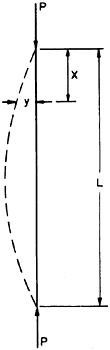
Consider, for example, an axially loaded column with ends unrestrained against rotation, shown in Fig. 5.43. If the member is initially perfectly straight, it will remain straight as long as the load P is less than the critical load P c. If a small transverse force is applied, the column will deflect, but it will return to the straight position when this force is removed. Thus, when P is less than P c, internal and external forces are in stable equilibrium.
If P = P c and a small transverse force is applied, the column again will deflect, but this time, when the...