Building Design and Construction Handbook, Sixth Edition
5.8: GRAPHIC-STATICS FUNDAMENTALS

5.8 GRAPHIC-STATICS FUNDAMENTALS

A force may be represented by a straight line of fixed length. The length of line to a given scale represents the magnitude of the force. The position of the line parallels the line of action of the force. And an arrowhead on the line indicates the direction in which the force acts.

Forces are concurrent when their lines of action meet. If they lie in the same plane, they are coplanar.

Parallelogram of Forces

The resultant of several forces is a single forces that would produce the same effect on a rigid body. The resultant of two concurrent forces is determined by the parallelogram law:

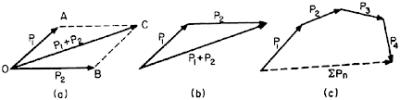
If a parallelogram is constructed with two forces as sides, the diagonal represents the resultant of the forces (Fig. 5.45a).


FIGURE 5.45: Addition of forces by ( a) parallelogram law; ( b) triangle construction; ( c) polygon construction.

The resultant is said to be equal to the sum of the forces, sum here meaning, of course, addition by the parallelogram law. Subtraction is carried out in the same manner as addition, but the direction of the force to be subtracted is reversed.

If the direction of the resultant is reversed, it becomes the equilibrant, a single force that will hold the two given forces in equilibrium.

Resolution of Forces

To resolve a force into two components, a parallelogram is drawn with the force as a diagonal. The sides of the parallelogram represent the components. The...

UNLIMITED FREE
ACCESS
TO THE WORLD'S BEST IDEAS

SUBMIT
Already a GlobalSpec user? Log in.

This is embarrasing...

An error occurred while processing the form. Please try again in a few minutes.

Customize Your GlobalSpec Experience

Category: Hydraulic Cylinders
Finish!
Privacy Policy

This is embarrasing...

An error occurred while processing the form. Please try again in a few minutes.