Cascade Separation of Powders

The system of separation of the materials by the cascade principle is illustrated most convincingly by a proportional model, reflecting the mass exchange taking place between stages.
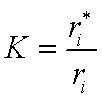
The value, characterising the degree of separation of a narrow size class in an individual cascade, can be presented in a simplified form:
where r i is the initial content of the particles of a narrow size class on the i-th stage of purification; r * i is the number of particles of the same size class, transferred from the i-th stage to stage ( i - 1); K or k is the coefficient of distribution.
At the same structure of the stages for each size class the distribution coefficient K will be constant. This coefficient does not depend on the number of the stage.
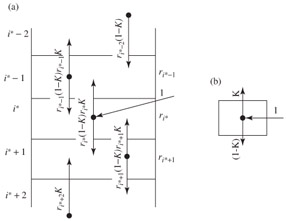
The proportional model of the distribution of particles of some fixed size class along the height of the apparatus at the supply to stage i * is shown in Fig. VII-1,a.
The nature of classification is controlled by the area of supply of the material into the flow. It is assumed that the initial mixture contains some number of the particles of the j-th size. The initial content of these particles will be regarded as unity. The degree of fraction separation of the fixed narrow size class...