Cascade Separation of Powders

Chapter IX: Irregular Cascades

1. COMPLEX CASCADES

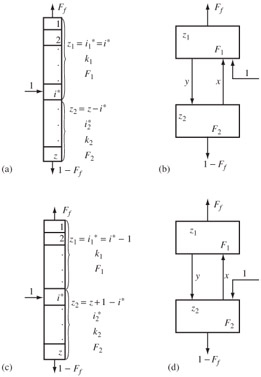
When organising a separation cascade, there may be deviations from the operating principle forming the base of the regular cascade model. For example, investigations of the carrying capacity of a two-phase flow in the conditions of classification showed different force effects of a dispersoid for the upper (above the feed section) and lower branches of the cascade (sections from i * + 1 to z). As a result, the separation processes in these branches is characterised by different distribution coefficients. For the upper branch it is k 1, for the lower branch k 2 with k 1 > k 2. Thus, we have an interlinked complex consisting of two regular cascades with their parameters (Fig. IX-1a,b).


Figure IX-1: Diagram of complex regular cascades produced from sections of the same type a) feed section in the upper branch; b) feed section in the lower branch; c,d) calculation schemes.

The second possible case of organisation of a complex cascade is that a classifier is produced from two parts (Fig. IX-2a,b), characterised by different flow rates of the continuum (different distribution coefficients). However, a regular cascade is realised within the limits of each part. The principal difference of the examined case from the previous one is that the relationship between the upper and lower columns is realised through the lower section of the upper cascade and the upper section of the lower cascade, whereas feeding is carried out through an arbitrary section of the...

UNLIMITED FREE
ACCESS
TO THE WORLD'S BEST IDEAS

SUBMIT
Already a GlobalSpec user? Log in.

This is embarrasing...

An error occurred while processing the form. Please try again in a few minutes.

Customize Your GlobalSpec Experience

Category: PLC (Planar Lightwave Circuit) Splitters
Finish!
Privacy Policy

This is embarrasing...

An error occurred while processing the form. Please try again in a few minutes.