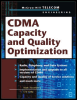
CDMA Capacity and Quality Optimization

Chapter 27: Conventional Reuse Principles

Overview

To distinguish code division multiple access (CDMA) from other modulation schemes, we call frequency division multiple access (FDMA) and time division multiple access (TDMA) schemes conventional reuse. [1] In these conventional reuse wireless systems, the modulation schemes are designed to be highly efficient of radio spectrum, designed to squeeze the most calls into a given frequency bandwidth. Once we have our efficient radio carriers, we make our conventional reuse systems efficient by managing interference as well as we can. [2] The effect of interference on cellular call quality is determined by the modulation scheme and by the radio environment, including radio path propagation and Rayleigh fading.

[1] We admit that this is our own term rather than an industry standard. We use it because it emphasizes the unique nature of spread spectrum.

[2] The reader may wonder why a book on CDMA is spending so much time on conventional reuse. There are three good reasons for this. First, CDMA systems are a technology evolution from FDMA and TDMA, and understanding the historical insights helps us understand the technology. Second, CDMA is strange and often counterintuitive, and we feel that it is often easier to understand what it is by understanding what it is not. And third, there are 700 million conventional reuse wireless telephones in use today, and a CDMA engineer should be well versed in their technology as well.

27.1 The AMPS Channel (FDMA)

As we described in Chap. 6,...

UNLIMITED FREE
ACCESS
TO THE WORLD'S BEST IDEAS

SUBMIT
Already a GlobalSpec user? Log in.

This is embarrasing...

An error occurred while processing the form. Please try again in a few minutes.

Customize Your GlobalSpec Experience

Category: Wireless Communications Services
Finish!
Privacy Policy

This is embarrasing...

An error occurred while processing the form. Please try again in a few minutes.