The M/M/m loss model has m servers but no waiting room. Calls that arrive when all servers are busy are turned away. This is called a loss system and was first investigated by Erlang. The transition rate diagram for this system is shown in Figure B.1. This is a birth-and-death queuing model with
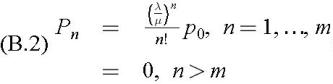
The steady state probabilities for this system are given as
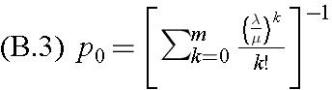
and
Thus,
 Figure B.1: Transition rate diagram for M/M/m loss model.
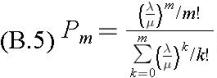
 The distribution of { p n} is truncated Poission. This formula is known as Erlang's first formula. An arriving unit is lost to the system when he finds on arrival that all channels are busy. The probability of this event P m is
Formula (B.5) is known as Erlang's loss (or blocking, or overflow) formula, or Erlang B formula, and is denoted by B(m, ?/ ?). The actual arrival rate into the system is then
The average number in the system is obtained from Little's formula:
Note that the average number in the system is also equal to the carried load. In the case of M/M/m loss model, the arrival user will either find an available server or be blocked in the system. If the user finds an available server, then she does not have to wait, and her waiting time in the system equals her service time such that the expected response time is 1/ ?.
Copyright Artech House, Inc. 2005 under license agreement with Books24x7


 TABLE OF CONTENTS